
Agentic Workforce Management: A Paradigm Shift from Manual Monitoring to Autonomous Operations
Workforce Management (WFM) has relied on manual intervention at every step for three decades, whereas Agentic WFM achieves continuous monitoring, proactive alerting, and automated execution of routine tasks by connecting data, AI, and automation. Based on McKinsey's 2025 AI report (62% of enterprises remain in early experimental stages) and BCG analysis (more jobs are being reshaped rather than replaced), and incorporating real-world cases such as DraftKings, the article elaborates on the three-stage evolution of Agentic WFM, its practical forms, and its profound impact on the role of WFM professionals—shifting from operational execution to orchestration, judgment, and accountability.
A real-time analyst spots an attendance deviation and immediately sends a message to the agent; a scheduling specialist reviews historical data to build the next quarter's staffing plan; a dispatcher opens a spreadsheet, weighing coverage against fairness rules. This is how workforce management (WFM) has operated for three decades—every step still requires a person to notice a problem before action happens.
Agentic Workforce Management is changing this model. When WFM data, AI, and automated operations are interconnected, the system can continuously monitor, identify key information, and handle routine tasks automatically before anyone asks.
What does "agentic" mean in WFM?
Agentic WFM means AI agents autonomously handle routine operational work without waiting for humans to initiate every task. Monitoring attendance, generating reports, flagging coverage gaps, posting overtime shifts—the system does all this automatically, and WFM professionals only step in when judgment is needed.
Most WFM teams currently use AI the same way they use a search engine: type a question, get an answer, close the tab. The workflow hasn't changed.
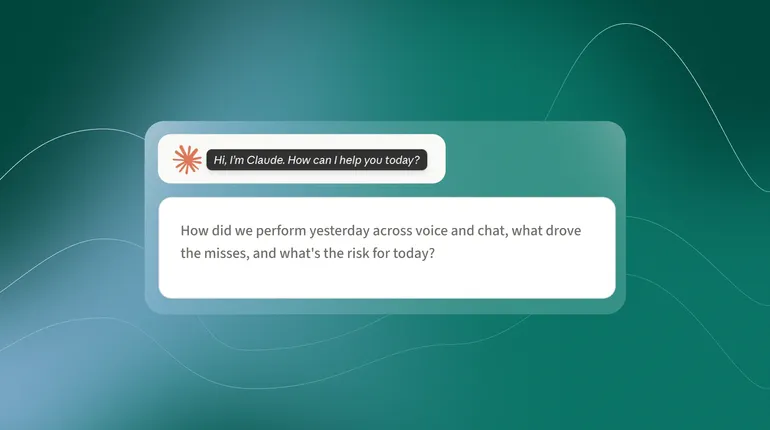
Agentic WFM is fundamentally different. A scheduling specialist doesn't manually piece together daily reports—they simply ask how the team performed across channels yesterday, what caused deviations, and what today's risks are. The system automatically pulls service levels, ticket volumes, and staffing data, identifies underperforming queues and why, and drafts a follow-up message for the team. No one opens a dashboard.
Where are most teams today?
Adoption can be broken into three phases. In the first, AI is a smarter search engine: ask, get answers, keep working. In the second, teams start automating tasks, like scheduled reports or Slack digests posted automatically before stand-ups. In the third, every tool a team uses connects to a unified AI system, and the focus shifts from operating dashboards to governing a system that executes autonomously and flags decisions needing human input.
According toMcKinsey's "The State of AI in 2025", 62% of organizations are still in early experimentation. The gap between building a clever prompt and truly changing how a team works is exactly where nearly every WFM team sits today. Closing that gap in the next year will create an advantage that latecomers will struggle to catch up with.
Agentic WFM in practice
A contact center supporting a service-enterprise market built a system that continuously monitors agent attendance. When an agent exceeds their break time, the system automatically detects it, adjusts the schedule, and sends a message directly to the agent—no one watches a dashboard. The system is in production, not a pilot, and the team has saved on labor costs.
At DraftKings,a WFM leader built an AI skill libraryfor the whole team to use, rather than relying on a single spreadsheet. When they take time off, the library keeps running; a new analyst inherits the same tools on day one. This is the shift from "an individual using AI at work" to "a team operating with AI."
How will WFM roles change?
The honest answer is: the shape of the work will change, but the function won't disappear. Routine monitoring, report generation, and standard adjustments will be absorbed by automation. What remains is harder to automate and more valuable: orchestration, judgment, and accountability.
BCG's analysis of AI's impact on workfound that more jobs will be reshaped than replaced, and the jobs that remain will demand higher expertise and a premium on judgment. If you instruct an AI model to optimize staffing, it will recommend near-maximum occupancy because that looks mathematically efficient. But anyone with real WFM experience knows this can lead to burnout risk and drive up attrition within weeks. That judgment—understanding what the data means before it tells you—is exactly what prevents agentic systems from making mistakes faster.
The window of opportunity is opening
The scattered personal prompts and helper scripts in WFM teams today are real but fragile. They depend on one person knowing how to ask the right questions and don't survive when that person is on vacation.
In your team, no one is better positioned than you to build a true agentic system. You understand the queues, the forecasts, and the "good" standards the data hasn't yet revealed. The tools and data connections are already there—all that's missing is someone deciding to take on the responsibility.